


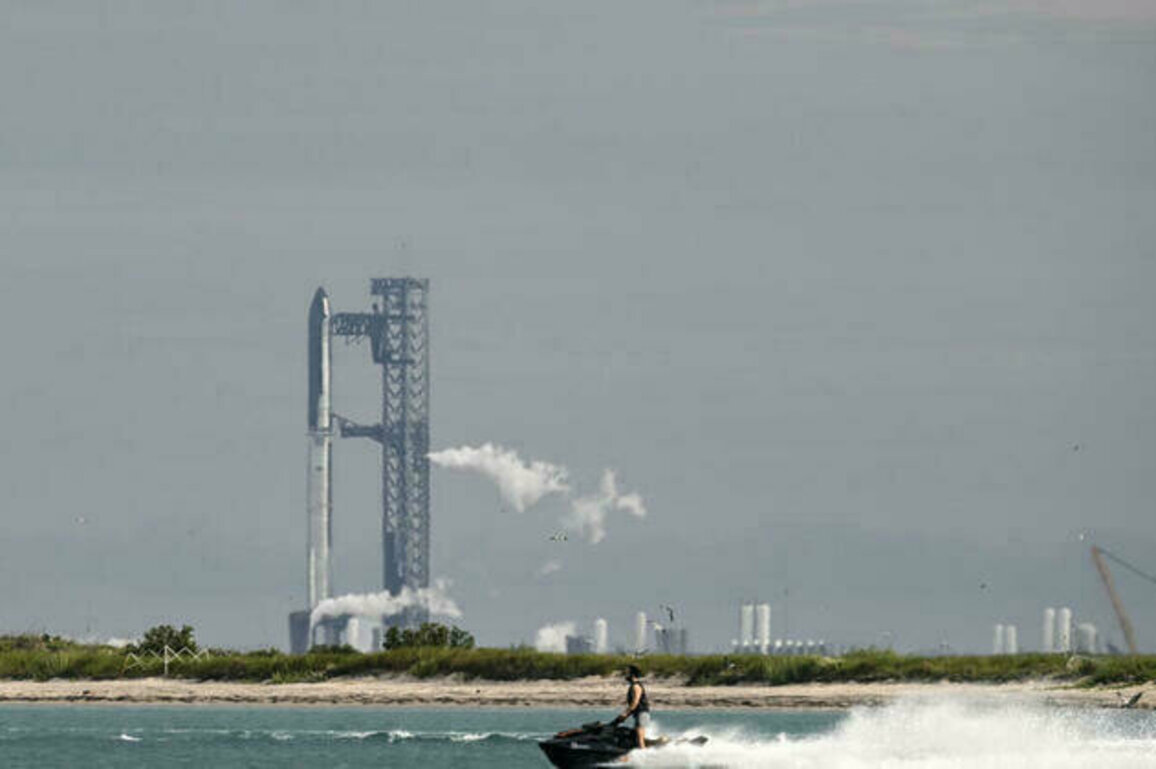
Bad weather forced SpaceX to postpone Mondays launch of its Starship rocket, the key vehicle for Elon Musks Mars ambitions and NASAs Moon missions. The tenth test flight, now expected Tuesday, comes amid scrutiny over the worlds most powerful rocket after several explosive failures raised questions about its viability.
Bad weather on Monday forcedSpaceXto postpone the latest launch of its massive prototypeStarship rocket, key to founderElon Musk's dreams of colonisingMarsand NASA's plans to return astronauts to the Moon.
The tenth test flight, which could now happen as soon as Tuesday, comes at a time of heightened scrutiny for the world's most powerful launch vehicle following a string of explosive failures that have begun raising doubts about its viability.
Standing 403 feet (123 meters) tall, the stainless steel behemoth was set to lift off from the company's Starbase in southern Texas in a window that opened at 6:30 pm local time (2330 GMT).
It was the second delay in two days after a ground-system leak, a relatively routine issue in spaceflight, scuppered an attempt on Sunday.
The mission aims to put the upper stage -- also known as "Starship" or simply "ship" and eventually intended to carry crew and cargo -- through structural stress testing as it flies halfway around the world before splashing down in the Indian Ocean.
SpaceX will also try out new heat-shield materials and attempt to deploy mock Starlink satellites as cargo. Unlike recent attempts, the "Super Heavy" booster will not be caught by the launch tower's giant "chopstick" arms but instead aim for a controlled splashdown in theGulf of Mexico.
The company's aggressive "fail fast, learn fast" approach has been credited with giving it a commanding lead in space launches through its Falcon rocket family.
Its Dragon capsules are the only American spacecraft ferrying astronauts to theInternational Space Station, while Starlink has become a geopolitical asset.
But concern is mounting over whether these successes will translate toStarship, a rocket unlike any before it. The upper stage has exploded in all three 2025 test flights.
Two scattered debris over Caribbean islands, while the third broke apart after reaching space. In June, another upper stage blew up during a ground "static fire" test.
'Spacefaring civilization'
Appearing on the webcast on Monday, Musk was characteristically bullish, reiterating his vision of Mars as a lifeboat for humanity should disaster strike on Earth.
But he added that beyond safeguarding survival, there are also more uplifting motives: "A future where we are a spacefaring civilization is infinitely more exciting than one where we are not," he said.
Even if the tenth flight succeeds, formidable hurdles lie ahead.
"There are thousands of engineering challenges left for both the ship and the booster, but perhaps the single biggest is developing a fully reusable orbital heat shield," said Musk, sporting a "Nuke Mars" T-shirt.
The slogan is a nod to the idea of detonating nuclear bombs over the Red Planet's ice caps to releasegreenhouse gasesand make it more Earth-like.
Another key obstacle is proving that Starships can be refueled in orbit with super-cooled propellant -- an unprecedented feat, but one that is essential for the rocket to carry out deep-space missions.
Delays toStarshipcould ripple throughNASA's Artemis program, which aims to return US astronauts to the Moon by mid-2027 using a modified version ofStarshipas the landing vehicle.
(FRANCE 24 with AFP)
Originally published on France24