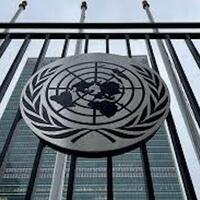


The General Assembly today elected Bahrain, Colombia, the Democratic Republic of the Congo, Latvia and Liberia as non-permanent members of the Security Council for a two-year term beginning on 1 January 2026.
All five candidates obtained the required two-thirds majority in a secret ballot and will replace Algeria, Guyana, the Republic of Korea, Sierra Leone, and Slovenia, whose terms expire on 31 December 2025.
In accordance with the established pattern of regional distribution, three seats were allocated for the African and Asia-Pacific States. The endorsed candidates — Bahrain, the Democratic Republic of the Congo, and Liberia — obtained 186, 183, and 181 votes, respectively. Latvia, the sole candidate for the Eastern European States, garnered 178 votes, and Colombia, the sole candidate for the Latin American and Caribbean States, secured 180 votes.
The newly elected members will join the Security Council alongside the five permanent members — China, France, the Russian Federation, the United Kingdom, and the United States — and the five current non-permanent members — Denmark, Greece, Pakistan, Panama and Somalia — whose terms run through the end of 2026.
World Horse Day
In other action, the Assembly adopted a draft resolution proclaiming 11 July as World Horse Day. However, a concern was raised about the growing number of international observances and the operational and financial burden they place on Member States and the United Nations Secretariat.
The text (document A/79/L.89), adopted by a recorded vote of 169 in favor to 1 against (United States), with no abstentions, invites Member States and other stakeholders to observe the Day every year, through activities aimed at raising awareness about the economic and social importance of the horse and the equine industry.
Introducing the draft, the representative of Mongolia described the horse as “one of the most important animals in human history” and pointed to its role in transportation, agriculture, farming and mining, as well as recreational fields such as horse-racing and tourism. But the number of horses, horse breeds and the horse industry are declining due to changes in lifestyles, technological advancements, economic fluctuations and environmental factors. Highlighting the sacred place that horses hold in his country’s pastoral nomadic culture, he said that it has one of the largest horse populations in the world. The text aims to encourage concrete actions to support the equine industry and conserve horse cultural heritage.
The United States’ delegate called for a vote on the draft, expressing concern about its preambular reference to the 2030 Agenda for Sustainable Development. The Agenda “impinges upon State sovereignty as a soft form of global governance”, she said.
Following the vote, the speaker for Mexico acknowledged the horse’s “undeniable links with rural communities, Indigenous Peoples and myriad cultural expressions”. However, while it is important to establish these ties, she stressed that “these actions can be conducted without proclaiming an international day”. Pointing to a “worrying proliferation of such proposals”, she recalled that a total of 27 international days and eight international years have been established over the General Assembly’s last two sessions. These involve operational, financial and time burdens for both delegations and the Secretariat, and she urged those present to “contemplate the balance between symbolism and functionality in the work of this General Assembly”.
…